

Live Wedding Painting in Dubai: The Irreplaceable Value of Human Art
Updated: Jul 23
...As the world becomes infinitely generated, the truly irreplaceable luxury becomes profoundly human....

On live wedding painting in Dubai, human authorship and the value of being truly witnessed.
We are entering an age in which images are becoming almost infinitely available.
Artificial intelligence can create an elaborate wedding setting, imagine a couture gown that has never existed or produce a beautiful portrait within seconds.
These possibilities are remarkable, and they will undoubtedly continue to influence the way artists work.
Yet the growing abundance of images has made me think more deeply about what gives an artwork lasting meaning. "My experience of live wedding painting in Dubai has shown me that the meaning of an artwork begins not only with how it is created, but with what the artist chooses to witness."
I did not arrive at this question through theory. It emerged from being physically present at weddings and private celebrations, painting for hours while observing the difference between the composed appearance of an event and its quieter inner life.
The flowers, architecture, fashion and lighting may have been designed with extraordinary care. That visible beauty matters. But beneath it, there is always another layer: the anticipation before an entrance, the subtle shift in the room when someone important arrives, the tension in a hand or a glance exchanged when no camera seems to be watching.
These moments are rarely announced. They reveal themselves only to someone who is paying attention.

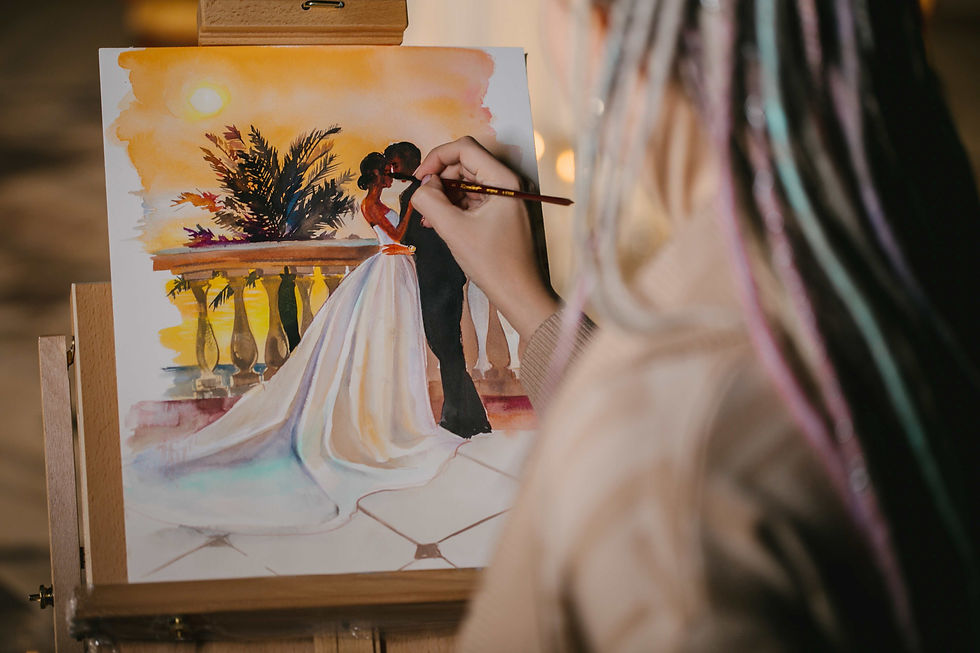
The Artist as Witness
A live wedding painting is created by someone who was there.
For me, this matters more than the simple fact that the artwork was painted by hand.
As a live wedding painter in Dubai, I spend hours within a celebration as it unfolds. I absorb its atmosphere, notice how the light changes and begin to understand which details carry emotional weight.
Another artist might witness the same wedding and create an entirely different painting. This subjectivity is not a weakness. It is what transforms an image into an interpretation.
I collect fragments of the day: the movement of a veil, the architecture of a bridal gown, the distance between two figures, a moment of stillness within a crowded room. Later, photographs may help me recover specific details, but they do not dictate the final composition.
"The painting does not need to reproduce everything with equal precision. Part of my role is to decide what should remain clear, what may soften and what deserves to come forward."
The finished work is therefore not an inventory of everything that happened. It is a personal interpretation of what the celebration revealed.

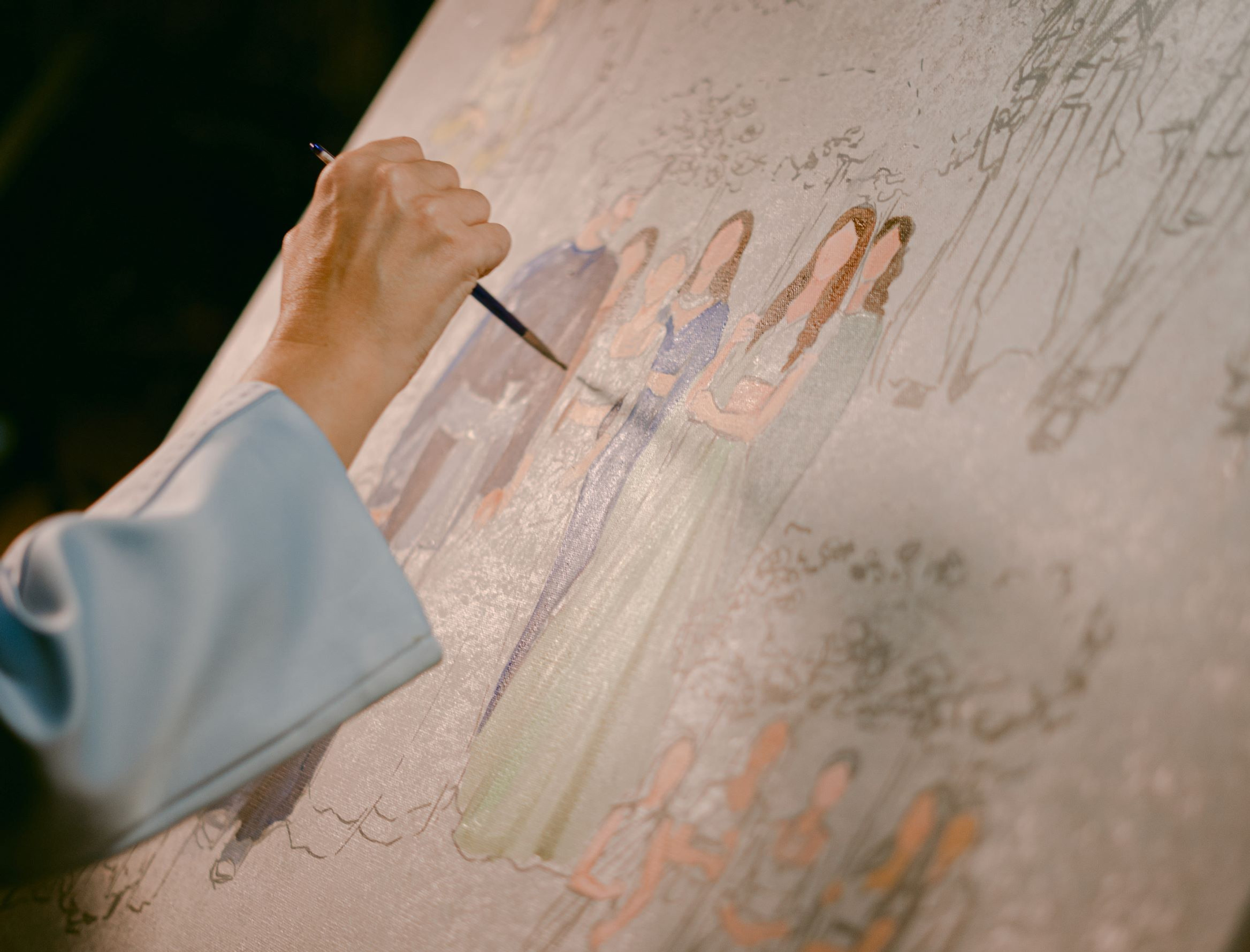
Technology as a Tool,
Not an Author
Human authorship does not depend on refusing technology.
I use photographs and digital references as part of my process. At times, I may also explore ideas with the assistance of AI. These tools can help me reconstruct a detail, examine an alternative composition or suggest the visual direction of a painting.
But they do not make the central artistic decisions.
They cannot determine which gesture carries the emotional meaning of the scene, whether the background should become quieter or how several moments from the day should be woven into one coherent memory.
Technology may support the process. The act of seeing, selecting and interpreting remains my own.
This distinction matters because authorship is not defined only by the physical movement of the hand. It is shaped by judgement, memory, intuition and responsibility for the finished work.
An artist decides what deserves attention.
That decision is where the artwork begins.


More Than a Digital Image
A physical painting also creates a different relationship with time.
Digital images move through our lives quickly. We see them, register them and continue scrolling. Even a beautiful photograph may disappear into an archive among thousands of others.
An original wedding artwork occupies real space. It remains on a wall, changes subtly with daylight and returns to the viewer over many years. The texture of the surface, the movement of the brush and the layers of pigment are not simply visual effects. They are part of the object’s physical presence.
"Over time, a bespoke wedding painting may become so deeply connected to a home that it is no longer experienced only as a record of the wedding day. It becomes part of the family’s visual memory."
On an anniversary, or during an otherwise ordinary evening, the artwork may suddenly reopen a feeling that had become difficult to name. This slow return is one of the qualities I value most in painting.
It does not demand constant attention.
It quietly waits for it.


The Rarity of Human Attention
Live wedding painting brings together qualities that have long belonged to the world of luxury: craftsmanship, personalization, original materials and time devoted to something that cannot be repeated.
Yet its deepest value lies in the complete attention of one artist given to one celebration.
The composition cannot simply be transferred to another couple. Even when similar techniques are used, the artwork belongs to the atmosphere, relationships and visual language of one particular day.
This is why I do not believe human artists need to compete with technology in speed, volume or technical perfection.
Our value lies elsewhere: in discernment, emotional intelligence and the ability to notice what no one requested and what no system was instructed to find.
As images become easier to generate, perhaps the value of art will be found less in the quantity of images we produce and more in the quality of attention behind the ones we choose to create.
The significance of a live wedding painting is not simply that it was made by a human hand.
It is that a moment was witnessed, understood and transformed through a human presence.
"As the world becomes infinitely generated, the truly irreplaceable luxury becomes profoundly human..."

Maria Zet Nova
Weaving Dreams into Reality

Comments